
Managing Rangelands for Sustainable Food Production in Namibia
HRI organized DAAD Summer School in Namibia 2019
In cooperation with the Geisenheim University of Applied Sciences, the German Institute for Tropical and Subtropical Agriculture (DITSL) in Kassel-Witzenhausen and our partners from the Namibia University for Science and Technology (NUST), the Hans-Ruthenberg-Institute was organizing a summer school for Namibian young scientists on the topic "Managing Rangelands for Sustainable Food Production in Namibia" in February/March 2019.
The aim was to train young scientists in a core topic of tropical research through the summer school, to establish important contacts in Southern Africa and to introduce the university location "Germany" to the participating students.
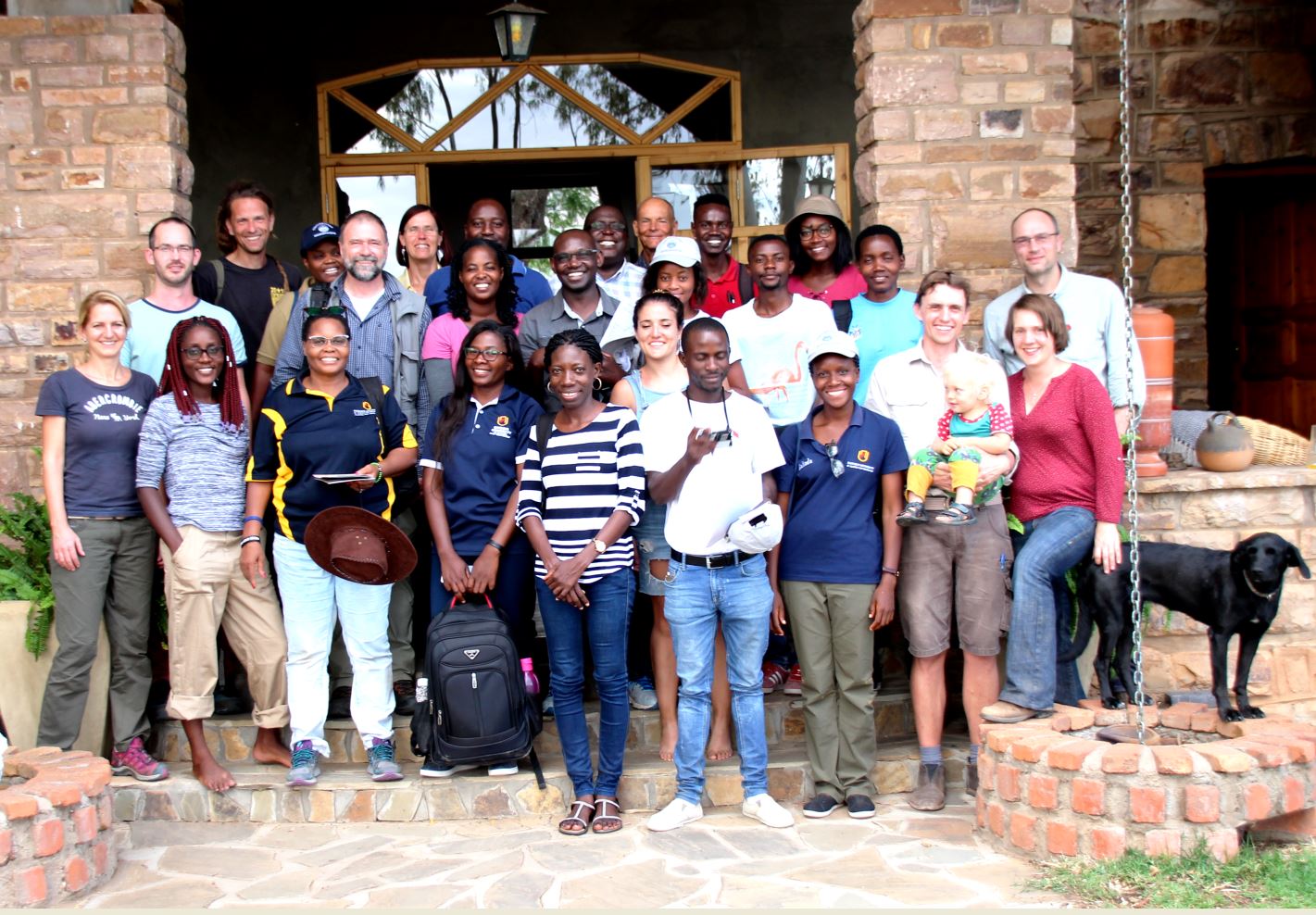
Global food security against the background of changing environmental conditions will be one of the key global topics of future education and research, especially in agricultural sciences. With a population forecast of around 2.5 billion in 2050, Africa is the continent with the greatest growth worldwide and the corresponding need for resources. In our dialogue with partner institutions around the world, we have noticed a strong increase in interest in agricultural science topics, which are particularly oriented towards the goals of sustainable development of the United Nations, the "Sustainable Development Goals". The topic of the summer school "Managing Rangelands for Sustainable Food Production in Namibia" therefore meets a core area of international efforts as well as the interests of many African students and young scientists. The areas beyond the agronomic dry-humid boundary are generally used for pasture farming and are of enormous importance for (global) food security. The main content of international agricultural science courses offered by the participating universities and colleges was taught and discussed in an interdisciplinary and transdisciplinary manner using Namibia as an example. The students had a direct connection to current issues of national agriculture as well as to a global, ecological context.
The University of Hohenheim offers numerous international study programmes, such as the DAAD top 10 award-winning "Agri-Tropis" programme. In such or similar MSc programmes the professors and scientists participating in the summer school are involved with lectures and thus direct contact persons. Thus, the students automatically come into contact with the teaching content of the respective modules and gain an idea of the type and manner of teaching and demands, as well as the goals of education at German universities. Since current research is continuously integrated into the teaching (research-based learning) in order to give the students a reference to important current questions as well as the essential basics, the current research focuses of the tropical agricultural sciences in Hohenheim, Kassel-Witzenhausen and Geisenheim (among others Sustainable Intensification, Production Systems and Digital Age, Migration and Agriculture Development, Food Security and Health) have consequently emerged as core points of the summer school. The excursion character of the second part of the summer school also allows the discussion and reflection of current research questions on the basis of concrete examples in the landscape. In particular, the summer school benefits from the preparatory work of the Geisenheim University of Applied Sciences, which supervises joint projects in the north of Namibia. The research questions of these ongoing projects were integrated into the summer school, so that the participants can be offered an up-to-date reference to theory as well as through on-site visits.
In terms of subject and content, the Summer School pursues a system-oriented approach to land use in Namibia's agroecosystems. The dry regions and savannahs of Namibia are characteristic for large parts of southern Africa. There are also many similarities to the Sahel regions north of the equator, insofar as a continuous rainy season occurs. The different agricultural and grazing systems along the climate and land use gradients in Namibia were analysed and discussed against the background of important biophysical, socio-cultural and economic factors. In particular, the grazing ecosystems and their sustainable use under different management systems were discussed. The following framework topics (RT) were defined for the summer school:
1) Ecology (climate, vegetation, geomorphology)
2) Biogeochemistry (Soil-Biosphere-Atmosphere Interactions)
3) Plant production and stress physiology
4) Animal sciences (production and nutrition)
5) Resource Dependent Herd Management, Pastoral Systems
6) Socioeconomics (organization and markets)
7) Landscape modelling
The summer school was supported by the German Academic Exchange Service (DAAD).